The Surprising Sanity of Using a Cache but Not Updating It
A while ago we added some client side caching to a biggish application at work, as you do. This led to an interesting observation I would like to share:
We clever monkeys realised that we have a handful of different call arcs that go through this cache, and that not all of them are similar in terms of functionality. For example some of them can handle the inconsistencies introduced by the cache, other cannot and were therefore modified to bypass the cache. So we end up with different code paths that return pretty much the same data, “just” one cached and one not. Urgh, not very nice. But probably the price one has to pay for having this cool cache that will make everything blazingly fast, right?
We dutifully monitored everything, including cache hit rates. And we did see really high hit rates, as expected for this cache, and the expected cache warming patterns when the system boots up. How nice when things go as expected!
Except that now and then something weird happens: it looks almost as if the cache randomly goes back into a mostly-cold state and then goes through the warming pattern again! How can that be? Unfortunately I don’t have a quality screenshot from our monitoring system (too much noise to be usable here), but the following graph shows the same behaviour from a Monte-Carlo simulation built to experiment with this behaviour:
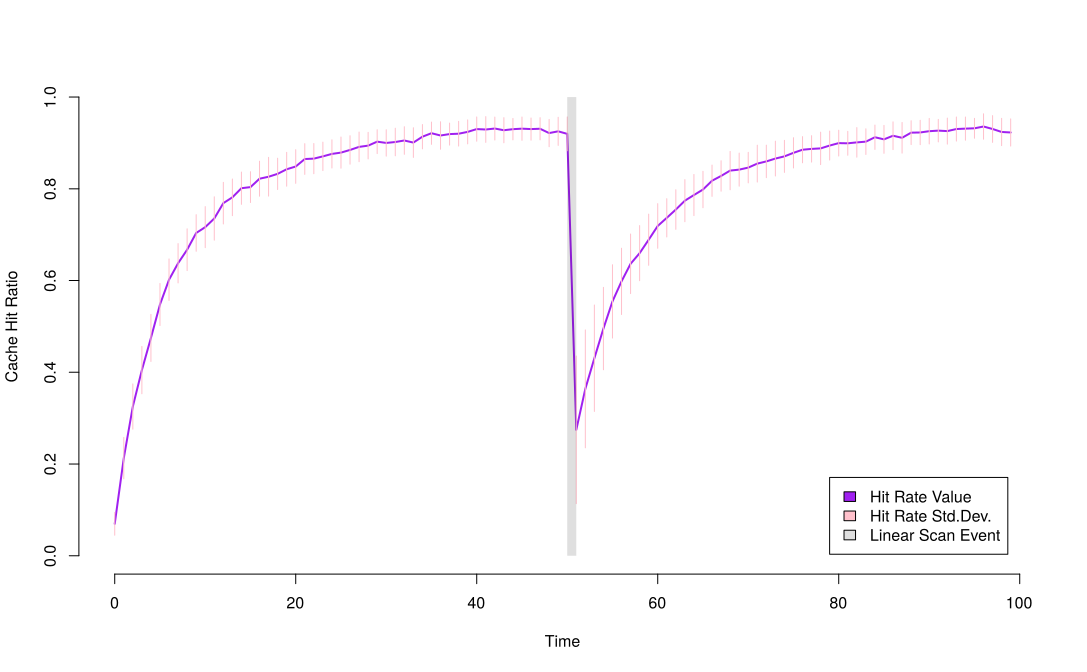
The simulation takes a simple LRU cache with a maximum size of 1000 entries. Access is following a Poisson distribution with 50% of all hits going into the first 300 cache entries, and a total of 10000 things that could be cached. The simulation makes 100 calls per time unit, and is run 100 times to get averages and deviation. The simulation code can be found at https://github.com/robertlemmen/cache-weirdness/blob/master/cache-sim1 You can clearly see the cache starting cold with a low hit rate, then warming up and reaching something resembling steady-state around 30 of whatever that time-unit is. All matching what one would expect.
Halfway through the run the cache is hit with a different access pattern, a linear scan through all items. In our system this was a housekeeping task, not so uncommon to have. This linear scan of course (in hindsight) destroys the LRU property of the cache, now the entries are pretty much random ones (funny how sequential and random can sometimes be the same thing), rather than the ones most likely to be used again soon. And with this, the return to a 10% cold state suddenly and sadly makes perfect sense!
In our case we ended up still using the cache, but in this call arc we do not update it when there is a cache miss, a capability I promptly added to the Cache::Async library (https://github.com/lizmat/Cache-Async). But I guess the benefits of using the cache for this access type are not that great and just bypassing the cache entirely would have been fine as well.
More interesting than the code-level fixes are the design consequences though: Having different code paths for access to the same data, just with different correctness guarantees, seems unfortunate but perhaps acceptable. But different code paths for access patterns that return the exact same data with the same guarantees, but with a different probability what will be called next? That seems insane! This entirely destroys the idea of domain driven design and pushing technicalities like caching into a transparent infrastructure layer. Even worse: the code we added the cache to is a service, the client making the calls with that access pattern is somewhere else. So we need to expose this nastiness in the API and can’t hide it under the carpet. And us adding the cache required changes to that client code, exposing unexpected far coupling.
So, caches: making your design shitty in unexpected ways!